





 Global
  United States
 Japan
Japan 






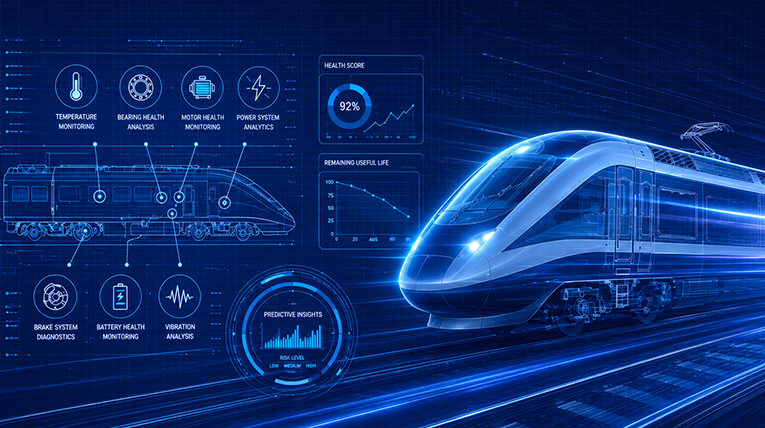
Railways today are generating more operational data than ever before. Modern locomotives are equipped with Vehicle Control Units (VCUs), onboard sensors, GPS modules, traction systems, braking systems, and auxiliary electronics that continuously generate diagnostic and performance data. Yet, despite this abundance of information, many railway operators still rely on reactive maintenance practices—responding only after a fault occurs.
This approach is becoming increasingly unsustainable. Unexpected equipment failures lead to service disruptions, increased maintenance costs, reduced locomotive availability and lower operational efficiency. As railway networks continue to expand and digitalize, operators need more than visibility into locomotive performance—they need actionable intelligence that enables them to predict failures before they occur.
This is where Diagnostic Retrieval & Analytics Systems (DRAS) are transforming railway operations.
Unlike conventional Remote Monitoring Systems (RMS), which primarily provide operational visibility, DRAS combines advanced diagnostics, AI-driven analytics and engineering intelligence to convert raw locomotive data into meaningful insights. The platform can be deployed on-premises or on private or public cloud infrastructure, depending on operational and customer requirements. It enables maintenance teams to detect issues early, identify root causes, anticipate potential failures and take timely corrective action.
Table of Contents
Understanding Diagnostic Retrieval & Analytics Systems (DRAS)
A Diagnostic Retrieval & Analytics System (DRAS) is an intelligent engineering platform that collects, correlates, and analyzes locomotive diagnostic data to deliver actionable insights. By combining real-time diagnostics, advanced analytics, and AI-driven intelligence, it enables railway operators to continuously assess the health of individual locomotives, identify emerging issues and make informed maintenance decisions before failures occur.
Instead of displaying thousands of isolated alarms generated by individual locomotive subsystems, DRAS correlates diagnostic events across power, propulsion, braking, safety, and auxiliary systems to identify underlying issues, assess component health and provide actionable maintenance recommendations.
This holistic approach helps maintenance teams prioritize critical issues, reduce unnecessary inspections and improve overall fleet reliability.
Why Railway Operators Need More Than Remote Monitoring
Remote Monitoring Systems (RMS) have played a crucial role in digitizing railway operations. They enable operators to monitor locomotive location, battery status, pantograph condition, energy consumption, communication health and numerous other operational parameters in real time.
However, visibility alone does not solve maintenance challenges. Engineers need answers to questions such as:
- Which component is responsible for repeated failures?
- Is the traction motor gradually degrading?
- Why are multiple locomotives reporting similar faults?
- Which locomotive is most likely to fail next week?
- Can maintenance be scheduled before service disruption occurs?
Answering these questions requires more than dashboards and alerts.
Every locomotive continuously generates thousands of operational data points—from traction motor performance and brake pressure to converter temperatures, battery voltage, vibration levels, GPS information and diagnostic logs. Individually, these signals provide limited value. Their true potential emerges when they are analyzed collectively.
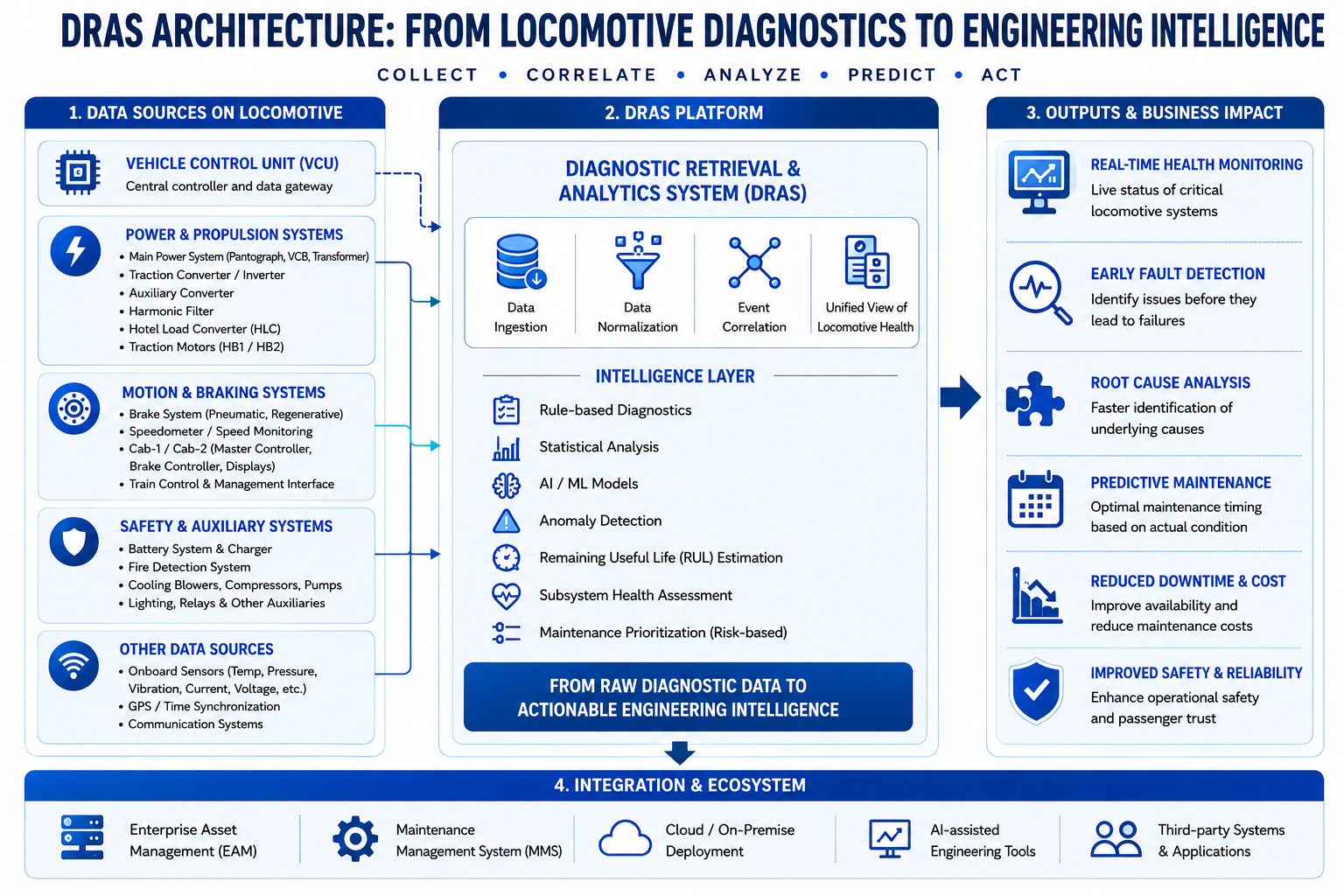
DRAS securely collects and normalizes diagnostic data from multiple Vehicle Control Units (VCUs) and onboard subsystems within a locomotive, correlates events across different systems, and applies AI-driven analytics to uncover hidden relationships between operational events. Instead of simply identifying abnormal parameters, DRAS determines the underlying causes of equipment degradation and provides actionable maintenance recommendations.
This transforms railway maintenance from monitoring assets to understanding their health, enabling engineering teams to predict failures before they impact operations.
From Engineering Intelligence to Predictive Maintenance
Collecting diagnostic data is only the first step. The true value lies in transforming operational events into engineering intelligence that enables faster and more informed maintenance decisions.
A modern DRAS goes far beyond data acquisition. It continuously retrieves diagnostic information from the Vehicle Control Unit (VCU) and critical locomotive subsystems, including the main power system, traction converter, auxiliary converter, harmonic filter, braking system, battery system, hotel load converter (HLC), driver cab systems, speed monitoring systems, fire detection systems and other onboard sensors.
By standardizing diagnostic information from these interconnected systems and correlating events throughout the locomotive, DRAS builds a comprehensive view of locomotive health. Its intelligence layer combines rule-based diagnostics, statistical analysis, and AI-driven analytics to detect anomalies, identify recurring fault patterns, assess subsystem health, estimate Remaining Useful Life (RUL) and prioritize maintenance activities based on operational risk.
These capabilities establish the foundation for predictive maintenance, enabling railway operators to transition from reactive repairs to proactive, data-driven maintenance strategies. Instead of relying solely on fixed maintenance schedules or waiting for failures to occur, maintenance decisions can be based on the actual condition of locomotive systems and early indicators of degradation.
By converting fragmented diagnostic data into actionable engineering intelligence, DRAS enables maintenance teams to transition from reactive maintenance to intelligent, condition-based maintenance. This approach improves locomotive availability, reduces unplanned downtime and maintenance costs, extends component life, minimizes service disruptions and enhances overall operational reliability.
Supporting Multi-Vendor Railway Locomotives
Railway operators often deploy locomotives from multiple manufacturers, each using different Vehicle Control Units (VCUs), communication protocols and diagnostic formats. This diversity makes it challenging to build a consistent diagnostic solution across locomotive platforms.
A modern DRAS addresses this challenge by integrating with multiple VCU implementations and standardizing diagnostic information within a common analytics framework. This enables maintenance engineers to assess locomotive health through a unified interface, regardless of the OEM-specific diagnostic format.
By delivering standardized diagnostics and engineering insights at the locomotive level, DRAS simplifies maintenance activities across heterogeneous railway environments while reducing dependence on proprietary diagnostic tools.
Looking Ahead
As railway systems continue to evolve, the role of DRAS is expected to extend beyond traditional locomotive diagnostics. Future deployments can integrate diagnostic information from additional onboard systems, AI-powered video analytics, train control and signaling interfaces, and next-generation IoT sensors to deliver richer engineering insights.
By correlating these diverse data sources, DRAS can enhance fault detection, accelerate root cause analysis and strengthen predictive maintenance by providing a more comprehensive understanding of locomotive health. Integration with Enterprise Asset Management (EAM) systems and AI-assisted engineering tools can further streamline maintenance workflows by recommending corrective actions, automatically generating maintenance work orders and helping engineers interpret complex diagnostic information more efficiently.
Ultimately, the future of railway maintenance will depend on how effectively operational data is converted into actionable intelligence that enhances reliability, improves safety and optimizes maintenance operations.
How VVDN is Enabling Intelligent Railway Diagnostics
At VVDN Technologies, we are helping railway OEMs and operators accelerate this transformation by developing cloud-native Diagnostic Retrieval & Analytics Systems that combine embedded engineering, cloud platforms, artificial intelligence and advanced analytics.
Our expertise spans secure edge computing, multi-vendor VCU integration, advanced analytics, AI-enabled diagnostics, intelligent data processing, and scalable deployment architectures across both on-premises and cloud environments.
By transforming complex locomotive diagnostic data into actionable engineering intelligence, VVDN enables railway organizations to improve locomotive reliability, optimize maintenance operations, reduce unplanned downtime and build the intelligent railways of tomorrow.